
Appearance
Introduction
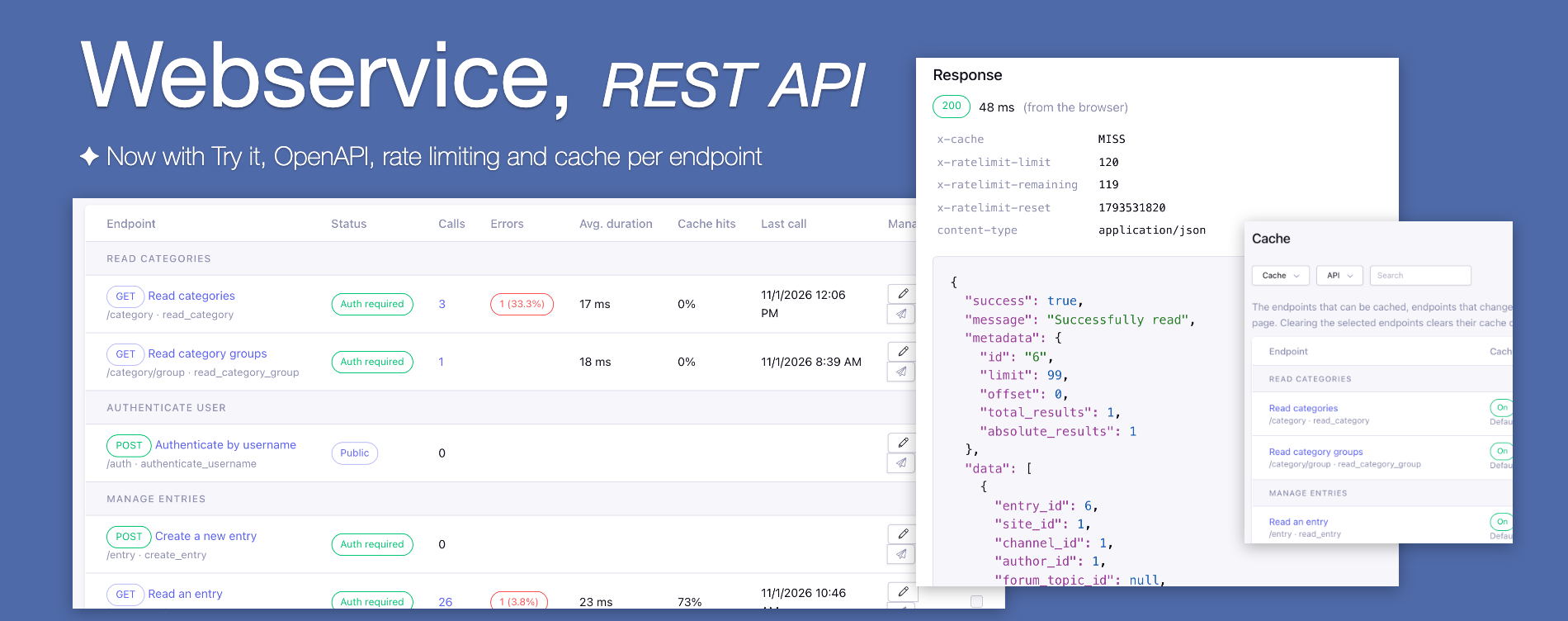
Webservice (previously Entry API) is a module that creates a REST API under the hood of the ExpressionEngine CMS. Out of the box it comes with an Auth API, an Entry API (with support for third party add-ons: Grid, Fluid, Relationship, Structure, SEO Lite etc...) and a Category API, and a Member API and Comment API that can be turned on in the settings. The API can be extended with your own APIs.
All endpoints, with their status, can be found on the Endpoints page in the CP, a cURL example on the edit page of an endpoint. The endpoints can also be exported as an OpenAPI specification.
Features
- Entry APICreate, read, update and delete entries, or search them.Read more →
- Your fields as JSONGrid, Fluid, Relationship, File and Structure data in and out, as JSON.Read more →
- Member, Comment and Category APIRegister and manage members, post comments and read categories, with the rules of ExpressionEngine.Read more →
- Auth APILog in with a username or email address and use the session for the next calls.Read more →
- Shortkeys and key/secretGive every app its own shortkey, or a key and secret, instead of a password.Read more →
- Auth via headersSend a Bearer shortkey, Basic auth, an API key and secret or a session in the request headers.Read more →
- Your permissionsA member can only do what its role allows in the control panel.Read more →
- Endpoints overviewEvery endpoint with its statistics, to enable, disable or make public.Read more →
- OpenAPI specificationAn OpenAPI 3 description of your endpoints, to download or to expose for your API tools.Read more →
- Try itSend a request from the control panel and see the response.Read more →
- API logsA log of every call, to see who called what.Read more →
- Response cacheA repeated call with the same data is answered from the cache.Read more →
- Rate limitingLimits per member and per IP address, against overload and guessing.Read more →
- Your own APIAdd your own endpoints, with the same authentication, permissions, logging and caching.Read more →